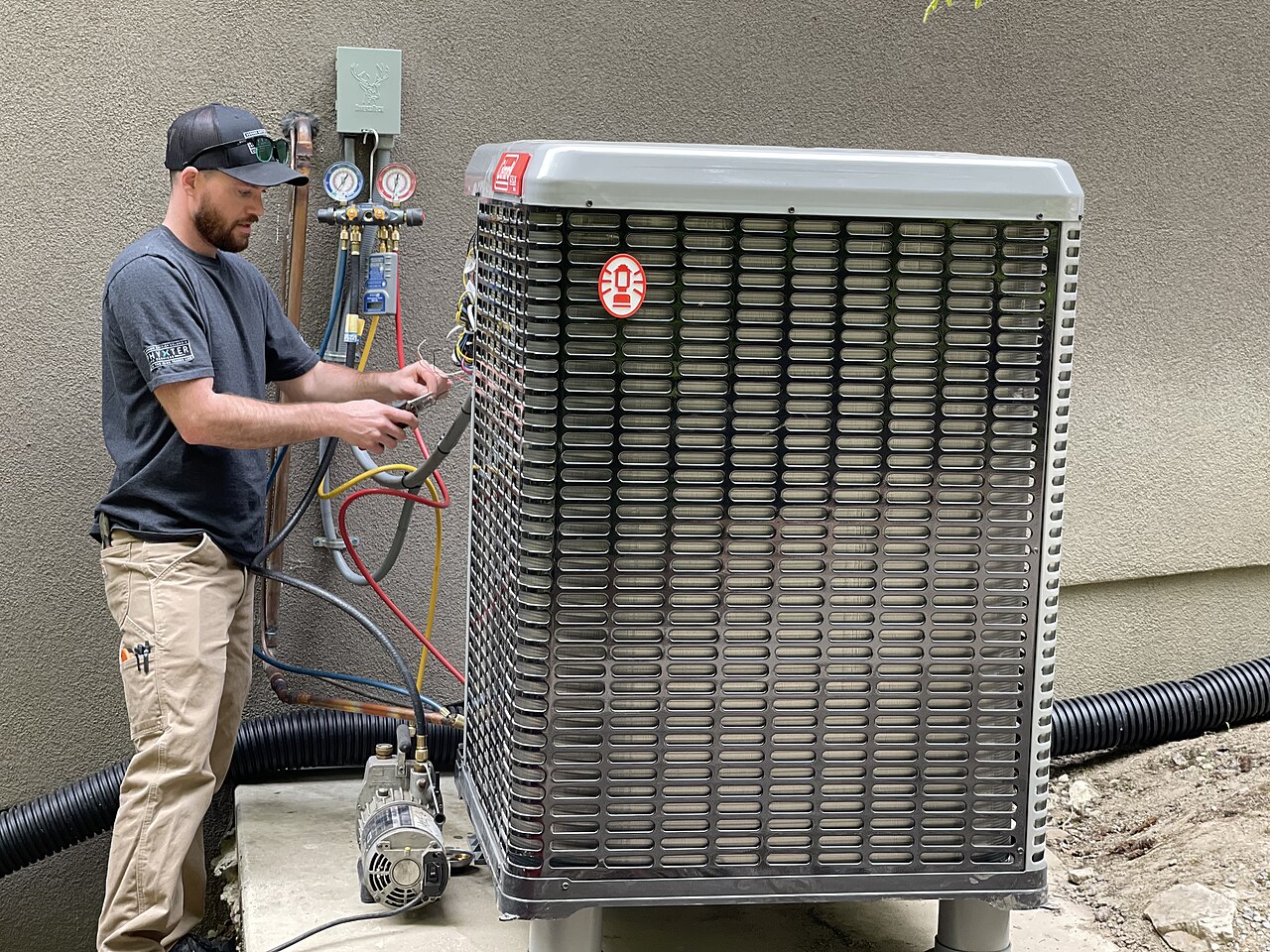
What a new central air conditioner costs installed in 2026, what moves the price, and when a repair makes more sense than a replacement.
Typical cost, installed · existing ductwork · 2026
$5,000–$12,000most U.S. homes
Enter the total installed price from your quote.
- Basic, single-stage
- $3,500–$6,500
- Mid-efficiency, two-stage
- $6,000–$9,500
- High-efficiency, variable-speed
- $9,000–$14,000
In this guide
- Cost at a glance
- Cost by system size
- Cost by efficiency rating
- Cost by brand
- Extra costs on your quote
- Why prices went up: the refrigerant change
- Tax credits and rebates in 2026
- Repair or replace? The $5,000 rule
- Example quote: 3-ton replacement
- How to get a fair price
- How long replacement takes
- Frequently asked questions
Most homeowners pay $5,000 to $12,000 to replace a central air conditioner in 2026. That price usually covers the outdoor condenser, a matching indoor coil, and installation on your existing ductwork. A typical 3-ton, mid-efficiency system lands around $6,000 to $9,500. A small, basic system can come in near $3,500, while a large, high-efficiency variable-speed system can pass $14,000. Replacing the air conditioner and the furnace at the same time usually runs $7,000 to $15,000 for a matched system.
The biggest price drivers are the size of the system, its efficiency rating, the brand and installer, and whether your home needs new ductwork, electrical work, or a new refrigerant line set. Prices also climbed in 2025 and 2026 as manufacturers switched to new refrigerants, so a quote a neighbor got three years ago is no longer a good benchmark.
Key points
- Most central AC replacements cost $5,000 to $12,000 installed. A typical 3-ton system runs $6,000 to $9,500.
- System size, efficiency rating (SEER2), brand, and extra work like ductwork drive the final price.
- The switch to new refrigerants raised equipment prices by roughly 15% to 30% since 2025.
- The federal tax credit for central AC does not apply to systems installed in 2026. Local utility rebates may still help.
- Use the $5,000 rule: if the system’s age times the repair cost is over $5,000, replacement usually wins.
AC replacement cost at a glance
| Item | Typical cost |
|---|---|
| 3-ton central AC, mid-efficiency, installed | $6,000 to $9,500 |
| Full range for AC-only replacement | $3,500 to $14,000 |
| AC and furnace replaced together | $7,000 to $15,000 |
| New ductwork, if needed | $2,400 to $6,600 |
| Typical lifespan | 15 to 20 years |
AC replacement cost by system size
Central air conditioners are sized in tons. One ton equals 12,000 BTU of cooling per hour. A common rule of thumb is about one ton for every 500 to 600 square feet, but climate, insulation, windows, and ceiling height all change the answer. A good contractor will run a Manual J load calculation instead of guessing or simply matching the old unit, which may have been the wrong size to begin with.
| System size | Home size | Installed cost |
|---|---|---|
| 1.5 tons | 600–900 sq ft | $3,500–$6,000 |
| 2 tons | 900–1,200 sq ft | $4,000–$7,000 |
| 2.5 tons | 1,200–1,500 sq ft | $4,500–$8,000 |
| 3 tons | 1,500–1,800 sq ft | $5,000–$9,500 |
| 3.5 tons | 1,800–2,100 sq ft | $5,500–$10,500 |
| 4 tons | 2,100–2,400 sq ft | $6,000–$12,000 |
| 5 tons | 2,400–3,000 sq ft | $7,000–$14,000 |
The 3-ton system is the most common replacement in U.S. single-family homes, which is why the typical range on the meter above tracks it. One size up or down moves the price by roughly $500 to $1,500.
These ranges assume your ductwork, electrical service, and furnace or air handler can stay in place. The low end of each range reflects a minimum-efficiency, single-stage unit from a value brand. The high end reflects a premium brand or a high-efficiency system in a high-cost area.
Cost by efficiency rating (SEER2)
Since 2023, air conditioner efficiency has been measured in SEER2, a stricter test than the older SEER rating. The federal minimum depends on where you live. In the North, new central air conditioners must reach at least 13.4 SEER2. In the South and Southwest, the minimum is 14.3 SEER2 for systems under 45,000 BTU and 13.8 SEER2 for larger ones.
| Efficiency tier | Typical SEER2 | Compressor | Price vs. minimum-efficiency |
|---|---|---|---|
| Standard | 13.4–15 | Single-stage | Baseline |
| Mid-efficiency | 15–17 | Single or two-stage | +15% to 25% |
| High-efficiency | 18 and up | Variable-speed | +30% to 50% |
In Texas, Florida, or Arizona, the extra cost of 17+ SEER2 usually pays back over the system’s life. In a northern state where the AC runs three months a year, a mid-efficiency unit is normally the better buy.
Variable-speed systems also control humidity better and run more quietly, which some homeowners value more than the energy savings. If your current system is more than 10 years old, ENERGY STAR says a correctly installed ENERGY STAR unit can save up to 20% on heating and cooling costs. The key words are “correctly installed.” Poor installation can wipe out much of the efficiency you paid for.
Cost by brand
| Brand tier | Examples | Installed cost |
|---|---|---|
| Value | Goodman, Payne, Armstrong | $3,500–$7,000 |
| Mid-range | Rheem, Ruud, American Standard, Bryant, York, Amana | $4,500–$9,500 |
| Premium | Carrier, Trane, Lennox | $5,500–$14,000 |
Choose the contractor first, then compare the brands they carry. Many brands share parts and factories, and a well-installed value unit often outlasts a poorly installed premium one.
Extra costs that can show up on your quote
- New ductwork: $2,400 to $6,600 for a typical retrofit. Sealing or repairing existing ducts costs much less and is worth asking about.
- Electrical work: $850 to $4,000, from a new circuit or outdoor disconnect at the low end to a panel upgrade at the high end.
- New refrigerant line set: usually $200 to $900, more for long or hard-to-reach runs. Some installers can flush and reuse the old lines if they are the right size and in good shape.
- Equipment pad: a modest add-on if the old pad is cracked, sinking, or the wrong size. Ask for it as its own line item.
- Permit: from about $100 to $1,500 depending on your city. Many contractors include it in the quote.
- Removal and refrigerant recovery: usually included, or $50 to $200 if it is itemized.
- Smart thermostat: $140 to $350 installed.
- Furnace or air handler: if your indoor unit is old or not compatible with the new coil, the job becomes a full system replacement.
Before you compare two quotes, make sure both say whether the line set is flushed or replaced and whether the permit is included. Those two items explain many $1,000 gaps.
Why AC prices went up: the refrigerant change
Under the federal AIM Act, new residential air conditioners have moved from R-410A refrigerant to lower-impact refrigerants called A2Ls, mainly R-454B and R-32. The new systems need different components and extra safety features, and the refrigerant itself costs more. Industry reports put new A2L systems roughly 15% to 30% above comparable R-410A models.
A few things are worth knowing if you are shopping now:
- You do not have to replace a working R-410A system just because the refrigerant is being phased down. It can still be serviced.
- Refrigerant for older systems is getting more expensive, so a leak repair on an aging R-410A unit may cost more than it used to.
- Some contractors still have leftover R-410A equipment. The EPA relaxed federal enforcement of the original installation deadline, but some states have their own rules. If you are offered one, ask whether it is allowed where you live and confirm that the full manufacturer warranty applies.
- New A2L outdoor units must be paired with a compatible indoor coil, so replacing only the outdoor unit is rarely an option.
The EPA explains the background on its HFC reduction page.
Tax credits and rebates in 2026
The federal Energy Efficient Home Improvement Credit used to pay up to $600 for a qualifying central air conditioner. According to the IRS, it applied only to equipment placed in service before December 31, 2025. A system installed in 2026 does not qualify.
Local help still exists. Many electric utilities pay a few hundred dollars for ENERGY STAR equipment, and some rebates need pre-approval, so search your ZIP code in the ENERGY STAR Rebate Finder before you sign.
Repair or replace? The $5,000 rule
A quick rule of thumb used by many HVAC pros: multiply the age of your system in years by the cost of the repair. If the result is over $5,000, replacement usually makes more sense. If it is under $5,000, repairing is usually the better deal.
| System age | Repair cost | Age × repair | Verdict |
|---|---|---|---|
| 12 years | $500 | $6,000 | Get replacement quotes |
| 6 years | $600 | $3,600 | Repair it |
It is a guideline, not a law. Other signs that point toward replacement:
- The system uses R-22 refrigerant. Production of R-22 ended in 2020, so any repair involving refrigerant is very expensive.
- The compressor has failed and the parts warranty has expired.
- You have paid for two or more significant repairs in the last two years.
- Your summer electric bills keep rising even though your usage has not changed.
- Some rooms never cool down, or the house feels damp even when the AC runs.
Example quote: 3-ton replacement
Here is an illustrative breakdown for a 3-ton, 15 SEER2 system replacing an old unit on existing ductwork. Your quote will be organized differently, but it should cover the same items.
| Line item | Cost |
|---|---|
| Outdoor condenser and matching indoor coil | $3,800 |
| Labor (two technicians, one day) | $2,200 |
| Line set flush or replacement | $600 |
| New pad, disconnect, and electrical whip | $350 |
| Permit | $200 |
| Smart thermostat | $250 |
| Removal of old unit and refrigerant recovery | $150 |
| Total | $7,550 |
Labor is 40% to 60% of the total, which is why the same system can be priced very differently from one company to the next.
How to get a fair price
- Get at least three written quotes. Prices for the same job often vary by thousands of dollars.
- Ask for a Manual J load calculation. An oversized unit cycles on and off, wears out sooner, and leaves the house humid.
- Ask for the exact model numbers of both the outdoor unit and the coil. The combination should have an AHRI matched-system certificate that confirms its real SEER2 rating.
- Ask which refrigerant the system uses and whether the line set will be replaced or flushed.
- Compare warranties. Major brands such as Carrier, Trane, and Lennox offer a 10-year parts warranty, but usually only if you register the system within a set window after installation (Carrier’s is 90 days). Without registration the standard term is often 5 years. Labor warranties vary from one year to ten, depending on the contractor.
- Schedule in spring or fall if you can. Contractors are less busy than in the middle of a heat wave and may be more flexible on price.
- Make sure the permit is included. An unpermitted installation can cause problems when you sell the house.
How long does AC replacement take?
A straightforward replacement on existing ductwork usually takes one day, often four to eight hours. If the job includes new ductwork, electrical upgrades, or a new furnace, plan on two to three days.
Frequently asked questions
How much does a new AC unit cost by itself?
The outdoor unit alone typically costs $1,200 to $5,800, depending on size, efficiency, and brand. You will almost always need a matching indoor coil and professional installation as well, which is why the total installed price is much higher.
What is the $5,000 rule for AC?
Multiply the age of the system by the repair cost. Above $5,000, replacement is usually the better investment. Below $5,000, a repair usually makes more sense.
How long do central air conditioners last?
Most last 15 to 20 years with regular maintenance. In hot, humid, or coastal areas such as Florida, 10 to 15 years is a more realistic expectation.
Can I replace just the outdoor unit?
Usually not. The outdoor unit and indoor coil are designed to work as a matched pair, and a mismatched system loses efficiency and may void the warranty. With the switch to new refrigerants, an old coil is generally not compatible with a new outdoor unit.
Does homeowners insurance cover AC replacement?
Not when the system simply wears out. Insurance may help if the unit is damaged by a covered event such as a fire, lightning strike, or falling tree. A home warranty may cover repairs, but most have coverage limits that fall well short of a full replacement.
Should I replace my AC and furnace at the same time?
If your furnace is more than 10 to 15 years old, replacing both together often saves on labor and ensures the indoor components are matched. If your furnace is relatively new and compatible, replacing only the outdoor unit and the coil is usually enough.
Last reviewed: October 31, 2026. Costs are estimated ranges compiled from manufacturer pricing, published contractor rates, and industry reports. Your quote will depend on your home, your location, and the contractor you hire. Read our editorial policy and disclaimer. Photo: Vernon Air Conditioning, Plumbing & Electrical Services, CC BY 2.0.
Leave a Reply