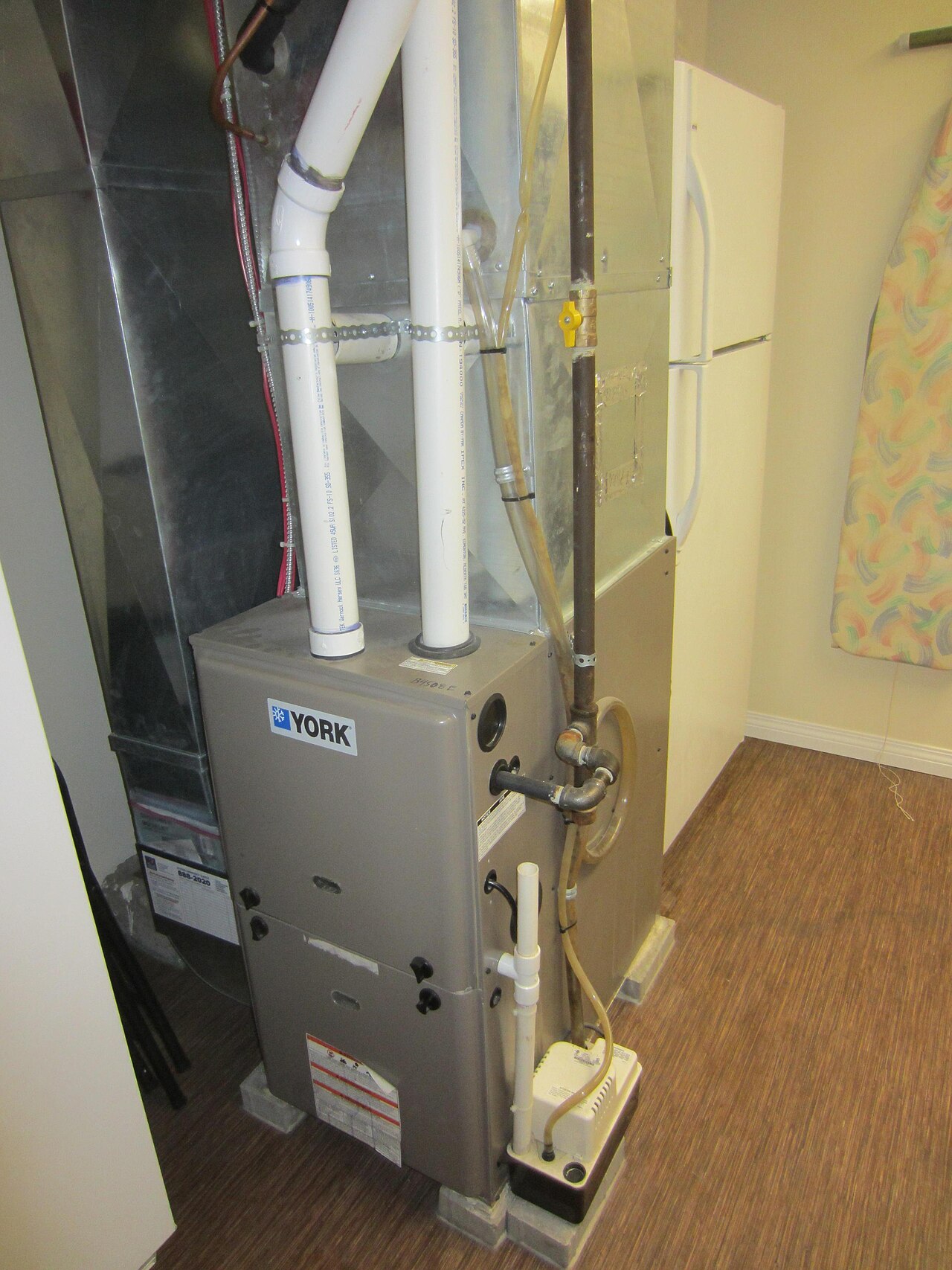
What a new furnace costs installed in 2026, how fuel type and efficiency change the price, and when a repair makes more sense than a replacement.
Typical cost, installed · existing ductwork · 2026
$2,800–$7,000most U.S. homes
Enter the total installed price from your quote.
- Standard, 80% AFUE
- $3,800–$6,200
- High-efficiency, 90–95% AFUE
- $5,200–$8,800
- Premium, 96%+ AFUE
- $7,500–$12,000
In this guide
- Cost at a glance
- Cost by fuel type
- Cost by efficiency rating
- Cost by size
- Cost by brand
- Extra costs on your quote
- Tax credits and rebates in 2026
- Repair or replace?
- Example quote: 80,000 BTU, 95% AFUE
- Replacing the furnace and AC together
- How to get a fair price
- How long replacement takes
- Frequently asked questions
Furnace replacement cost runs $2,800 to $7,000 for most homeowners in 2026, and the national average is about $4,800. Fixr puts the average at $4,800, Bob Vila at $4,743, and Angi at $4,814. That covers the furnace, labor, and removal of the old unit. A standard 80% efficiency gas furnace on existing ductwork usually runs $3,800 to $6,200 installed, and a high-efficiency model runs $5,200 to $12,000 depending on its rating and how much venting work your house needs.
Fuel type, efficiency, and size set the base price. Venting, ductwork, and permits decide how far your quote drifts above it. Replacing the furnace and air conditioner together usually runs $7,000 to $15,000 for a matched system, the same range as in our AC replacement cost guide.
Key points
- Most furnace replacements cost $2,800 to $7,000 installed. The national average is about $4,800.
- Fuel type matters most: electric $2,000 to $7,000, natural gas $3,800 to $10,000, propane $3,700 to $14,200, oil $6,750 to $10,000.
- A 90%+ AFUE condensing furnace costs roughly $1,000 to $1,800 more than an 80% unit and needs PVC venting and a condensate drain.
- The federal tax credit for furnaces does not apply to equipment installed in 2026. Utility rebates may still help.
- Furnaces last 15 to 30 years depending on fuel and source. Past 15 years, or with a cracked heat exchanger, replacement usually beats repair.
Furnace replacement cost at a glance
| Item | Typical cost |
|---|---|
| National average, installed | About $4,800 |
| Range for most homeowners | $2,800 to $7,000 |
| Gas furnace, 80% AFUE, installed | $3,800 to $6,200 |
| Gas furnace, 90% to 95% AFUE, installed | $5,200 to $8,800 |
| Furnace and AC replaced together | $7,000 to $15,000 |
| Typical lifespan | 15 to 30 years |
Furnace cost by fuel type
Your fuel is usually set by what is already connected to the house. Switching fuels means new lines, tanks, or electrical work, and it can add thousands to the job.
| Fuel type | Installed cost | Typical lifespan |
|---|---|---|
| Electric | $2,000 to $7,000 | 20 to 30 years |
| Natural gas | $3,800 to $10,000 | 15 to 20 years |
| Propane | $3,700 to $14,200 | 15 to 20 years |
| Oil | $6,750 to $10,000 | 15 to 25 years |
These ranges match across Fixr, Bob Vila, and Angi. Electric furnaces are the cheapest to buy and install, but they use resistance heat, which ENERGY STAR says a heat pump can beat on running cost. Propane has the widest range because a buried tank costs far more than an above-ground one. Oil furnaces cost the most up front, and converting from oil to gas averages around $8,500 according to Angi. The rest of this guide focuses on natural gas furnaces, which make up most replacements.
Cost by efficiency rating (AFUE)
AFUE (Annual Fuel Utilization Efficiency) tells you how much of the fuel becomes heat. A 96% AFUE furnace turns about 96 cents of every fuel dollar into heat. The federal minimum for a new gas furnace is currently 80% AFUE. A DOE rule raises that minimum to 95% AFUE for gas furnaces manufactured on or after December 18, 2028. The rule is still in litigation after the Supreme Court sent it back to the appeals court in June 2026, DOE is weighing a delay to January 1, 2030, and an 80% furnace you buy today is not affected. Condensing furnaces have a second heat exchanger and range from 90% to 98.5% AFUE, according to the U.S. Department of Energy. They cost more because they are built and installed differently.
| Efficiency tier | Unit only | Installed |
|---|---|---|
| Standard, 80% to 89% AFUE | $700 to $1,800 | $3,800 to $6,200 |
| High-efficiency, 90% to 95% AFUE | $1,500 to $3,700 | $5,200 to $8,800 |
| Premium, 96%+ AFUE | $2,800 to $6,200 | $7,500 to $12,000 |
The table uses HomeGuide’s 2026 gas furnace figures. Other sources agree: PickHVAC lists 80% single-stage units at $3,800 to $6,800 installed and 96% to 98% modulating units at $6,500 to $12,000. Budget Heating says a 90% furnace costs about $1,000 to $1,200 more than an 80% unit before venting.
Stages matter too. A single-stage furnace runs at full blast or not at all. A two-stage furnace has a low setting for mild days, and a modulating furnace adjusts its output in small steps. Forbes Home lists furnace units, before labor, at $700 to $3,300 for single-stage, $1,000 to $3,600 for two-stage, and $1,300 to $6,600 for modulating. Budget Heating says a variable-speed blower adds roughly $1,000 to $2,000 to the installed price. Both run more quietly and hold temperatures steadier.
ENERGY STAR says certified gas furnaces save an average of about $160 a year in northern states and about $60 a year in the South. At those rates, a $1,000 to $1,800 efficiency premium pays back in roughly 6 to 11 years in a cold climate and much longer in a warm one.
Furnace cost by size (BTU)
Furnaces are sized in BTU per hour. A bigger house needs more BTU, but climate, insulation, and windows change the number, so two 2,000 square foot homes can need very different furnaces. An oversized furnace short-cycles and wears out sooner. Ask for a Manual J load calculation instead of matching the old unit.
| Home size | BTU range | Furnace cost |
|---|---|---|
| 1,000 sq ft | 30,000–60,000 | $1,200–$2,000 |
| 1,500 sq ft | 45,000–90,000 | $1,800–$3,000 |
| 2,000 sq ft | 60,000–120,000 | $2,400–$4,000 |
| 2,500 sq ft | 75,000–150,000 | $3,000–$5,000 |
| 3,000 sq ft | 90,000–180,000 | $3,600–$6,000 |
| 4,000 sq ft | 120,000–240,000 | $4,800–$8,000 |
Fixr and Bob Vila publish the same cost-by-size figures. They sit below those sites’ all-in averages, so treat them as the furnace itself and expect labor, venting, and extras on top. The BTU ranges are Fixr’s and are wide because climate drives heating demand.
Cost by brand
| Brand tier | Examples | Installed cost |
|---|---|---|
| Value | Goodman, Coleman | $2,100–$6,300 |
| Mid-range | Carrier | $2,400–$8,000 |
| Premium | Lennox, Trane | $3,000–$9,500 |
The ranges overlap because every brand sells entry-level and top series. Pick the installer first, then compare the models they carry.
Extra costs that can show up on your quote
- PVC venting and condensate drain: $325 to $1,250 when you move from an 80% furnace on a chimney to a condensing unit, which vents through PVC out a side wall and needs a drain. A condensate pump, if there is no floor drain nearby, runs $150 to $450 installed.
- New ductwork: $2,000 to $5,000 for a full installation or replacement. Sealing existing ducts costs much less.
- Gas line work: $500 to $2,000 to run a new line, plus $50 to $200 for a gas line permit.
- Electric furnace circuit: $175 to $500 for a new 240-volt outlet or circuit. A large electric furnace can also push an older panel past its limit; see our electrical panel upgrade cost guide.
- Oil or propane tank: $600 to $2,500 for a 250-gallon tank.
- Permit: $50 to $1,500 depending on your city. Most cities require a mechanical permit and an inspection for a furnace swap; many contractors include it in the quote.
- Removal and disposal: usually included, or $50 to $330 if it is billed separately.
- Thermostat: $125 to $350 for a smart thermostat, installed.
- Whole-house humidifier: $400 to $800 installed. HomeAdvisor lists $392 to $766 with an average of $579.
- Whole-house air cleaner: $500 to $1,000 for an extended media filter, $750 to $3,500 for a UV system, and $2,000 to $5,000 for a HEPA system, based on Angi and HomeAdvisor figures.
If your water heater shares the old chimney, ask the installer to confirm it still vents safely after the swap. A new chimney liner for a water heater left alone on the flue adds $900 to $2,500. See our water heater replacement cost guide if it is also near the end of its life.
Tax credits and rebates in 2026
The federal Energy Efficient Home Improvement Credit paid up to $600 for a qualifying high-efficiency gas furnace. The IRS says it covers qualifying property placed in service only through 2025, so a furnace installed in 2026 does not qualify. Some older cost guides still list the credit as running through 2032, but that date was moved up.
The federal heat pump credit ended the same way, and the state-run Home Energy Rebates no longer cover swapping a gas furnace for a heat pump: DOE guidance effective May 29, 2026 limits them to electric-to-electric replacements and new construction. ENERGY STAR notes that a ducted heat pump can often replace a furnace and air conditioner in one swap, or pair with an existing furnace as a dual-fuel system. Ask for quotes on both options.
Local help still exists. Many utilities pay rebates on high-efficiency furnaces and heat pumps, and some require pre-approval. Search your ZIP code in the ENERGY STAR Rebate Finder before you sign.
Repair or replace?
HomeAdvisor puts the average furnace repair at $318, with most homeowners paying $133 to $505. Bigger parts cost more: HVAC.com lists an ignitor at $300 to $400, a blower motor at $450 to $1,500, and a heat exchanger at $2,000 to $3,000.
Two rules of thumb help. Angi treats 15 years as a good age cutoff and suggests replacing when repairs near 30% of a new furnace’s price, about $1,500 to $2,000. Many HVAC pros also multiply the furnace’s age by the repair cost, and replacement usually wins when the result is over $5,000.
| Furnace age | Repair | Age × repair | Verdict |
|---|---|---|---|
| 8 years | Ignitor, $350 | $2,800 | Repair it |
| 14 years | Blower motor, $900 | $12,600 | Get replacement quotes |
| 22 years | Heat exchanger, $2,500 | $55,000 | Replace it |
Other signs that point toward replacement:
- The heat exchanger is cracked. The EPA warns that cracked heat exchangers can release combustion gases, including carbon monoxide. Install CO alarms, which many states require in homes with fuel-burning appliances (Florida, for example, wants one within 10 feet of each bedroom in homes built since 2008), and have the furnace inspected every year.
- The furnace is 15 or more years old and needs repairs more than once a year.
- Heating bills keep rising while your usage stays the same.
- It makes loud grinding, screeching, or banging sounds, or cycles on and off constantly.
Fixr says most furnaces last 15 to 20 years, and Bob Vila says 15 to 30. The Department of Energy’s analysis assumes an average of 21.5 years for gas furnaces, so a well-maintained unit at 18 is not automatically on its last legs.
Example quote: 80,000 BTU, 95% AFUE
Here is an illustrative breakdown for a two-stage, 95% AFUE gas furnace replacing an old 80% furnace that vented into a chimney, in a house with sound ductwork. Your quote will be organized differently, but it should cover the same items.
| Line item | Cost |
|---|---|
| 80,000 BTU, 95% AFUE two-stage furnace | $2,800 |
| Labor (two technicians, one day) | $1,800 |
| PVC intake and exhaust venting, condensate drain | $450 |
| Duct transitions, gas fittings, and materials | $400 |
| Permit | $300 |
| Smart thermostat | $250 |
| Removal and disposal of old furnace | $150 |
| Total | $6,150 |
Labor is about 30% of this total. Fixr puts furnace labor at 10% to 40% of the job, which is why the same unit can be priced very differently from one company to the next.
Replacing the furnace and AC together
If both systems are old, doing them in one visit often saves labor and gives you matched equipment. A matched furnace and AC system usually costs $7,000 to $15,000 installed. HVAC.com puts a furnace and 3-ton AC together at about $10,500 to $13,500, and Budget Heating at $11,590 to $14,100 for a typical replacement. Our central AC replacement guide covers what drives the cooling side of that price.
If your AC is newer, replacing only the furnace is usually fine. Ask the installer to confirm it works with your existing indoor coil and that the AC warranty is not affected.
How to get a fair price
- Get at least three written quotes from licensed HVAC contractors. Licensing is set by your state or county, not federally, so check the contractor with your state board. Prices for the same job often differ by thousands of dollars.
- Ask for a load calculation. The contractor should size the furnace with a Manual J calculation, not just match the old unit.
- Ask for exact model numbers and the AFUE rating of each furnace, and whether it is single-stage, two-stage, or modulating.
- Ask how the furnace will vent and drain. For a condensing unit, get the PVC run, the wall penetration, and the condensate drain in writing.
- Ask whether the quote covers ductwork changes, gas line work, and the permit. Those three items explain many $1,000 gaps between bids.
- Compare warranties. Check the parts warranty, whether it requires registration, the heat exchanger coverage, and how long the contractor guarantees labor.
- Schedule early if you can. Replacing a furnace in spring or summer avoids the rush, and bids tend to be easier to negotiate.
How long does furnace replacement take?
A straightforward swap on existing ductwork usually takes 4 to 10 hours, according to Fixr. Bob Vila says installs can run as long as 18 hours. Plan on two days if the job adds new venting through a wall, ductwork changes, or a new gas line.
Frequently asked questions
How much does a new furnace cost by itself?
The unit alone costs $700 to $1,800 for an 80% AFUE gas furnace, $1,500 to $3,700 for 90% to 95%, and $2,800 to $6,200 for 96% or higher, based on HomeGuide’s 2026 figures. Labor, venting, and extras are billed on top, which is why the installed price is much higher.
How long do furnaces last?
Most last 15 to 20 years, and some sources give up to 30. Electric furnaces tend to last longest, at 20 to 30 years. Regular maintenance helps any furnace reach the upper end.
Is a 96% AFUE furnace worth the extra cost?
It depends on your climate. In a cold state with long heating seasons, the savings can pay back the $1,000 to $1,800 premium in roughly 6 to 11 years. In a mild climate it may never pay back, and an 80% furnace is usually the better buy.
Is there a federal tax credit for a new furnace in 2026?
No. The Energy Efficient Home Improvement Credit applied only to property placed in service through 2025, according to the IRS. Check utility and state rebates in the ENERGY STAR Rebate Finder instead.
Should I get a heat pump instead of a furnace?
It can make sense, especially if you also need a new air conditioner. ENERGY STAR says a heat pump can deliver up to three times more heat energy than the electricity it uses, and a ducted model can often replace both. Get quotes for both options, since cold climates may need backup heat.
Should I replace my furnace and AC at the same time?
If both are more than 10 to 15 years old, replacing them together often saves labor and gives you matched equipment. If one is relatively new, replace only the one that failed.
Last reviewed: October 31, 2026. Costs are estimated ranges compiled from published cost guides, manufacturer information, and government sources. Your quote will depend on your home, your location, and the contractor you hire. Photo: Wtshymanski, CC BY-SA 4.0. Read our editorial policy and disclaimer.