What tree removal costs in 2026 by tree size, what pushes the price up, and what stump grinding, cleanup, and permits add to the bill.
Typical cost, removal only · stump extra · 2026
$400–$1,100most U.S. homes
Enter the total price from your quote.
- Small tree, under 30 ft
- $150–$450
- Medium to large, 30–80 ft
- $450–$1,500
- Very large or crane, 80+ ft
- $1,000–$2,500
In this guide
- Cost at a glance
- Cost by tree size
- What makes removal cost more
- Stump grinding and removal
- Debris and wood chip haul-away
- Extra costs on your quote
- Permits and protected-tree rules
- Trim or remove?
- When homeowners insurance pays
- Power lines and DIY risks
- Best time of year
- Example quote: 65-foot tree near a house
- How to get a fair price
- Frequently asked questions
Most homeowners pay $400 to $1,100 to remove a tree in 2026. Fixr puts the typical range at $400 to $1,100, and Lawn Love at $385 to $1,070. Published averages run from $435 at Fixr to $906 at This Old House, with Bob Vila at $750 and Lawn Love at $850. Height drives the price: a small tree under 30 feet runs $150 to $450, while a very large tree over 80 feet runs $1,000 to $2,000 before any crane.
Stump grinding is usually billed separately at $100 to $500 per stump. A tree close to your house or power lines, a dead or diseased tree, and a storm emergency all raise the price, and an emergency call can reach $5,000. Get at least three written quotes and confirm each one covers the stump, the cleanup, and the permit.
Key points
- Most tree removals cost $400 to $1,100. Averages in published guides run from $435 to $906.
- By height: under 30 ft $150 to $450, 30 to 60 ft $450 to $1,200, 60 to 80 ft $800 to $1,500, over 80 ft $1,000 to $2,000.
- Stump grinding adds $100 to $500 per stump. Cleanup and haul-away can add $50 to $300 if it is not included.
- Homeowners insurance generally pays only when a tree damages a covered structure, and debris removal is often capped at $500 or $1,000.
- Never work within 10 feet of a power line. Call your utility and hire a line-clearance qualified crew.
Tree removal cost at a glance
| Item | Typical cost |
|---|---|
| Average, depending on the guide | $435 to $906 |
| Range for most homeowners | $400 to $1,100 |
| Small tree, under 30 ft | $150 to $450 |
| Very large tree, over 80 ft | $1,000 to $2,000 |
| Crane-assisted removal | $1,500 to $2,500 |
| Stump grinding, per stump | $100 to $500 |
| Emergency removal | $450 to $5,000 |
| Trimming instead of removal | $200 to $760 |
Tree removal cost by tree size
Height is the main pricing factor because taller trees need more rigging, more time, and a bigger crew. Fixr, Bob Vila, This Old House, and Lawn Love publish similar height brackets, and the table shows the range most of them support.
| Tree size | Height | Removal cost |
|---|---|---|
| Small | Up to 30 ft | $150–$450 |
| Medium | 30–60 ft | $450–$1,200 |
| Large | 60–80 ft | $800–$1,500 |
| Very large | Over 80 ft | $1,000–$2,000 |
Bob Vila says a tree over 80 feet may need a crane. Fixr puts crane-assisted removal at $1,500 to $2,500 and says it typically applies to trees 80 feet and taller. Some contractors price by the foot instead, at $2 to $5 per foot according to Fixr.
What makes removal cost more
Size sets the base price, and the site and the tree’s condition move it from there. Bob Vila says hard access alone can change the cost by 25% to 50%.
| Situation | Typical cost |
|---|---|
| Fallen tree on open ground | $75 to $300 |
| Tree uprooted by a storm | $300 to $500 |
| Dead tree | $75 to $400 |
| Hollow or rotten dead tree | $400 to $900 |
| Diseased tree | $400 to $900 |
| Crane needed | $1,500 to $2,500 |
| Emergency or storm-damage call | $450 to $5,000 |
Fixr and Bob Vila both say trees near a house, fence, or power lines cost more, but neither gives a fixed surcharge. The crew has to rig the tree and lower it in pieces instead of felling it whole, so expect quotes near the top of the size bracket. Fixr says emergency rates can run two to three times normal.
If you are not sure a tree is sick, a pre-removal inspection for disease costs $40 to $450 according to Fixr.
Stump grinding and removal cost
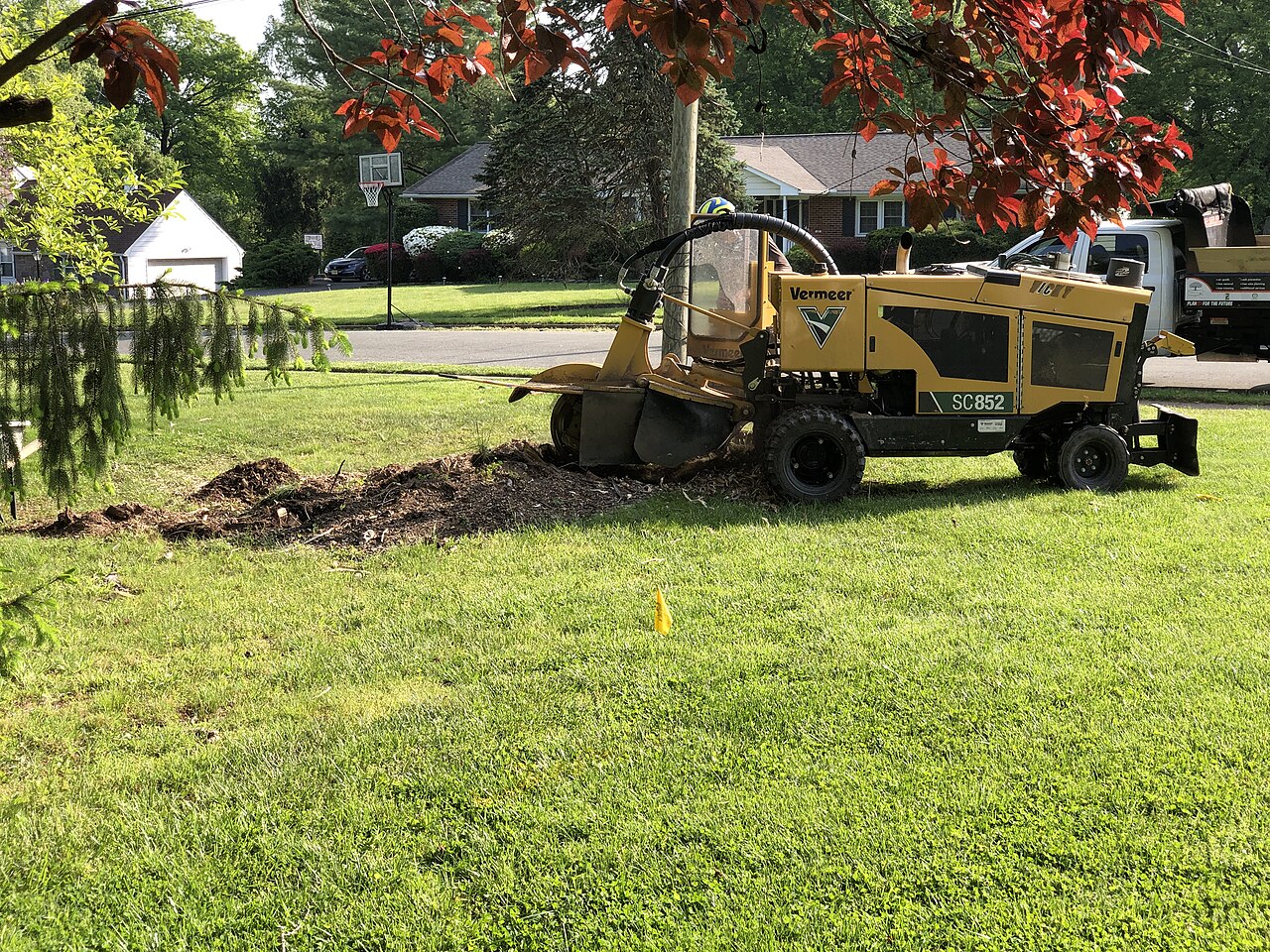
A removal quote usually stops at the stump. Grinding chews the stump down below ground level and leaves a pile of wood chips. Full removal pulls out the roots too, which costs more. Both count as digging, so contact 811 a few business days ahead to have buried gas, electric, and water lines marked; every state requires that call by law before any digging, and it also applies if you rent a grinder yourself. Fixr prices removal and grinding of a 75-foot tree together at about $1,100.
| Service | Typical cost |
|---|---|
| Stump grinding, per stump | $100 to $500 |
| Stump removal, flat rate | $100 to $400 |
| Each extra stump, same visit | About $50 |
| Full root removal after grinding | $500 to $1,000 |
| Stump grinder rental, per day | $100 to $150 |
Fixr puts grinding at $100 to $500, Bob Vila at $100 to $400, and Lawn Love at $180 to $525. Large stumps and exposed roots push toward the top of the range. Ask for the stump price as its own line, since Bob Vila lists extra stumps in the same visit at about $50 each.
Debris and wood chip haul-away
Some crews include hauling away the limbs and logs, and some bill it separately. Fixr lists debris cleanup after removal at $150 to $300, Lawn Love lists hauling at $100 to $200, and Bob Vila at $50 to $100. Chipping on site and hauling runs $50 to $100 at Fixr. Chipping by the hour runs $75 to $125.
You can usually keep the wood chips for mulch and the logs for firewood. Splitting logs costs about $100 a tree. Tell the estimator whether you want the material left or gone.
Extra costs that can show up on your quote
- Permit: $60 to $150 at Fixr’s typical rate, depending on location. Many contractors include it.
- Travel fee: $50 to $200 flat, or $0.25 to $0.75 per mile, for longer trips.
- Land clearing before removal: $100 or more to clear brush or obstacles so the crew can work.
- Disease inspection: $40 to $450 before you commit to cutting the tree down.
- Multiple trees: ask for a reduced rate when you have more than one taken down.
Permits and protected-tree rules
Many cities protect trees above a certain trunk size, even on private land. The rules vary widely. In Austin, Texas, a tree 19 inches or more in diameter, measured 4.5 feet above the ground, is protected and needs a permit to remove. Heritage trees of listed species at 24 inches or more are generally off limits. In San Bruno, California, the heritage threshold is only 6 inches for native oak, redwood, and a few other species, and 10 inches for any other tree.
Bob Vila adds that a protected species may need permission to remove. Check with your city’s arborist or planning office before you sign, and with your HOA if you have one, since HOA covenants can add their own approval step. The BBB warns that fines for unpermitted work are expensive. Ask the contractor in writing who pulls the permit.
Trim or remove?
Trimming costs less. Bob Vila lists $200 to $760, and Lawn Love lists $255 to $655 with an average of $420. If the tree is healthy and the problem is branches over a roof or a driveway, trimming usually solves it, though it may need to be repeated.
Removal makes sense when the tree is dead or dying, has a hollow or cracked trunk, has started to lean suddenly, or has roots lifting out of the ground. Have a certified arborist look at it first. If a healthy tree stands close to your foundation and you see new cracks, get the foundation checked before you blame the tree. Our foundation repair cost guide shows what that work runs.
When homeowners insurance pays
Insurance pays for what a tree damages, not for removing a tree that simply came down. Farm Bureau Financial Services says coverage may apply when a tree falls on your home or another covered structure, and it may also pay to remove the tree. The cause of the fall does not matter, whether wind, hail, or lightning.
If a tree falls and damages nothing, you pay for removal. United Policyholders says policies typically pay up to $500 or $1,000 for tree debris removal, and only when the tree damaged the dwelling or another structure. A fallen tree that blocks your driveway or a ramp may still be covered. Check the debris removal limit on your own policy. If the tree damages your roof, our roof repair cost guide covers the repair side, and our AC replacement guide covers a crushed outdoor unit.
Insurers may deny a claim when the tree was dead, rotten, or poorly maintained, and they generally do not pay to remove a healthy-looking tree as a precaution.
Power lines and DIY risks
If any part of the tree is near a power line, stop and call your utility. OSHA’s electric power standard (29 CFR 1910.269) defines line-clearance tree work as work within 10 feet of energized lines. Only trained, qualified workers may go inside that distance, and unqualified workers must stay at least 10 feet away. Do not climb the tree, prune it, or lean a ladder against it. Bob Vila notes that a power company may remove a tree for free if it threatens its lines.
DIY removal only makes sense for small trees in open areas. Bob Vila limits it to trees under 15 feet and recommends a pro above that. Lawn Love puts a DIY job at $220 to $360, with a chainsaw at $60 to $200, but warns that a mistake can cost more than hiring a pro. If a tree lands on your house or a neighbor’s fence, the repair is on you.
Best time of year
Fixr says the dormant season, February or March, is the best time to take a tree down, and that winter may be cheaper because crews are busier in summer. Bob Vila says some tree services offer off-season discounts in some regions. Do not wait for a discount if the tree is dead. Bob Vila advises removing dead trees sooner rather than later.
Example quote: 65-foot tree near a house
Here is an illustrative breakdown for a 65-foot maple in a front yard, 20 feet from the house, with the stump ground out. A tree this size runs about $1,000 in the large bracket, and tight access adds roughly 30%.
| Line item | Cost |
|---|---|
| Remove 65-ft tree in sections (climb, rig, and lower) | $1,300 |
| Grind 24-inch stump | $350 |
| Chip and haul away limbs and logs | $200 |
| Permit | $100 |
| Travel fee | $75 |
| Total | $2,025 |
How to get a fair price
- Get at least three written quotes and compare what each one includes: stump, cleanup, permit, and hauling.
- Ask whether a certified arborist will do or supervise the work. In most states, anyone can call themselves an arborist. ISA Certified Arborist is a private credential, not a government license: holders pass an exam and keep up continuing education, and you can verify a credential on the ISA website.
- Ask for proof of liability insurance and workers’ compensation, then call the insurer to confirm. The BBB says your homeowners policy alone may not cover an injury during tree work.
- Check state licensing and local permits. No federal license exists, and most states leave tree work to the city or county. A few license it at the state level: Maryland requires a Licensed Tree Expert for paid work on trees taller than 20 feet, New Jersey registers tree care businesses with its Board of Tree Experts, Connecticut licenses arborists for pruning and tree care, and California requires a C-49 Tree and Palm contractor license for jobs of $1,000 or more or any job that uses employees. Ask who pulls the permit.
- Ask how the tree will come down. Find out whether it will be cut in pieces, whether a crane is needed, and who pays if it damages your roof, fence, or lawn.
- Ask if the crew is qualified for line-clearance work when any branch is near a power line.
- Avoid large upfront deposits. The BBB advises paying in stages tied to the work.
Frequently asked questions
How much does it cost to cut down a tree?
Most homeowners pay $400 to $1,100. A small tree under 30 feet costs $150 to $450, a medium tree $450 to $1,200, a large tree $800 to $1,500, and a very large tree over 80 feet $1,000 to $2,000, before stump grinding.
How much does stump grinding cost?
Stump grinding costs $100 to $500 per stump, and it is usually billed on top of the tree removal. Extra stumps in the same visit often cost about $50 each. Pulling out the roots entirely costs $500 to $1,000.
Does homeowners insurance pay for tree removal?
Only when the tree damages a covered structure, such as your house. Debris removal is often capped at $500 or $1,000. If a tree falls and damages nothing, you generally pay for removal yourself, unless it blocks your driveway or a ramp.
Do I need a permit to remove a tree on my own property?
Often yes, if the tree is large or a protected species. Austin requires a permit at 19 inches in diameter, and San Bruno protects some trees at 6 inches. Call your city before you hire anyone, because fines for unpermitted work can be steep.
Is trimming cheaper than removing a tree?
Yes. Trimming runs about $200 to $760, with Lawn Love averaging $420. It only works if the tree is healthy, and you may need to repeat it.
What do I do if a tree is touching a power line?
Stay at least 10 feet away and call your utility. Do not try to cut or move the tree.
Last reviewed: October 31, 2026. Costs are estimated ranges compiled from published cost guides, government sources, and insurance information. Your quote will depend on your property, your location, and the contractor you hire. Photo: Famartin, CC BY-SA 4.0. Read our editorial policy and disclaimer.